
DISCOUNTED EDUCATION PRICING! CALL 1-877-891-8411. We Gladly Accept School Purchase Orders!
If you’re researching a poster printer machine for your school, you’re probably trying to answer one of three questions:
Those are the right questions.
But most districts make this decision using incomplete criteria. They compare specs and price — without evaluating instructional impact, adoption behavior, or long-term cost patterns.
A poster printer machine is not just equipment.
In a school environment, it becomes part of your instructional infrastructure.
Let’s walk through this the right way.
Before you evaluate machines, evaluate the role of visuals in your building.
High-performing classrooms rely on visible thinking:
When those visuals are large, permanent, and readable from anywhere in the room, they become cognitive tools — not decorations.
A district literacy coordinator recently told me:
“When our anchor charts moved from 11×17 to 24×36, student reliance increased immediately. They stopped asking for clarification and started checking the wall.”
That shift matters.
Large visuals reduce repeated teacher explanations.
They support independent retrieval.
They lower cognitive load for struggling learners.
If your school is investing in Title I intervention, MTSS frameworks, or STEM expansion, large-format visual access should align with that investment.
Otherwise, you are funding programs without funding visibility.
Not every school needs one.
But most do.
You likely need an in-house poster printer machine if:
The key signal isn’t volume alone.
It’s friction.
If teachers delay or avoid printing because it requires a purchase order, a drive to a print shop, or reimbursement paperwork, then instruction is being constrained by logistics.
Infrastructure should remove friction — not create it.
One of the biggest purchasing mistakes districts make is overbuying.
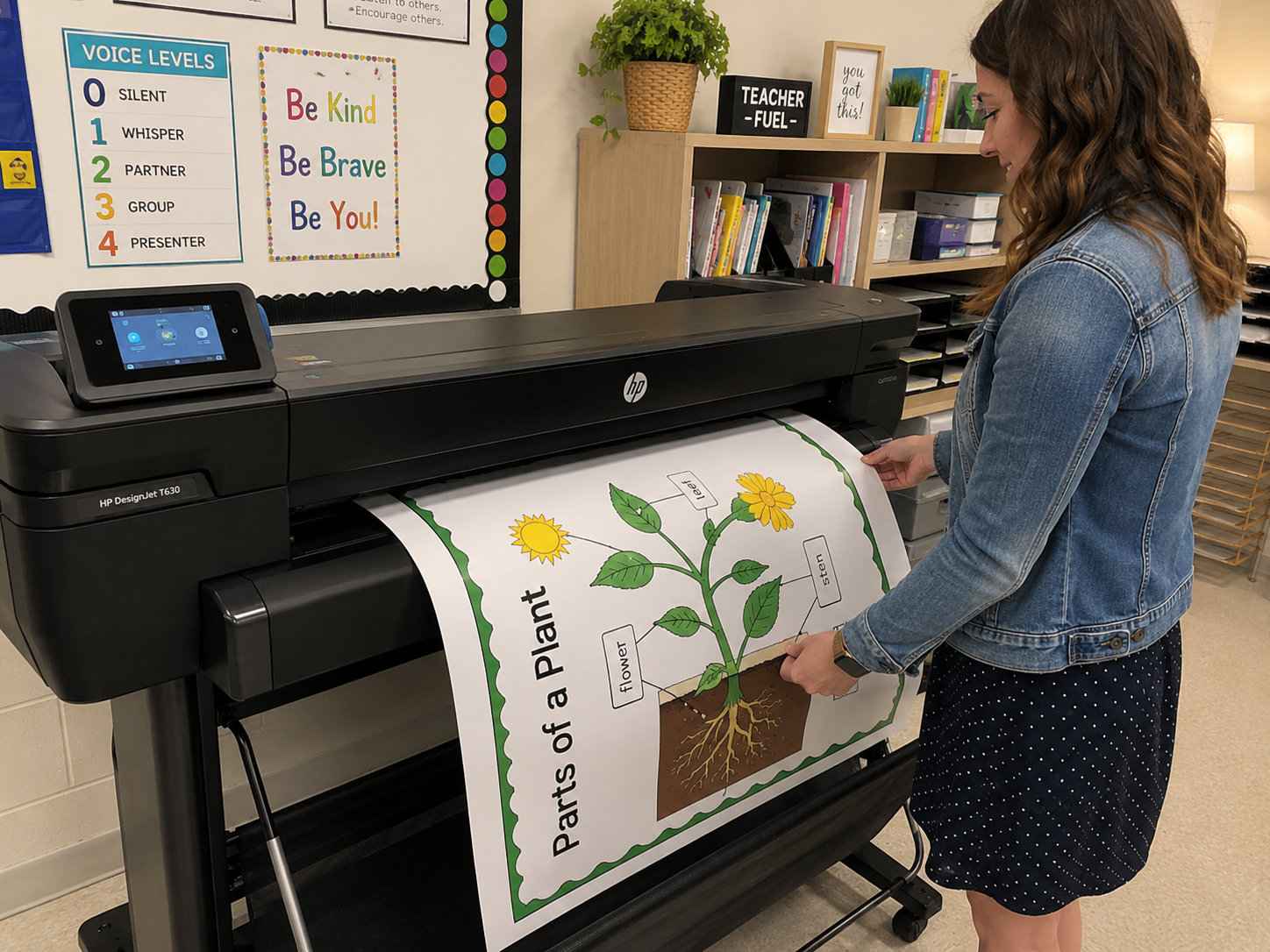
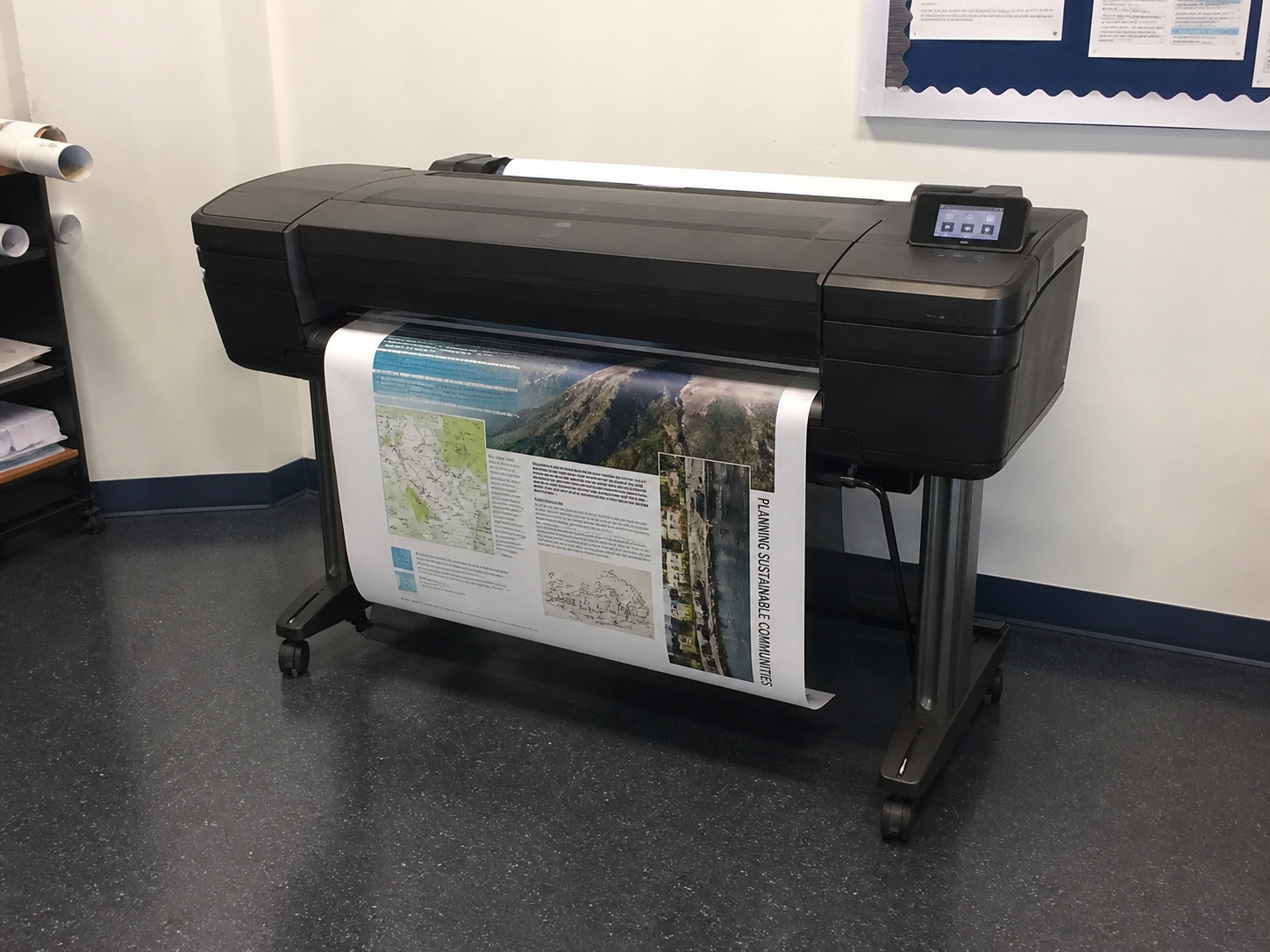
For most elementary and middle schools, a 24-inch-wide poster printer machine is ideal.
It supports:
Larger 36-inch poster printer systems are typically unnecessary unless the school produces architectural-scale prints or oversized banners regularly.
Right-sizing protects your budget and increases ROI.
Bigger is not better.
Appropriate is better.
Let’s look at a practical scenario.
Mid-sized elementary school:
Conservative estimate:
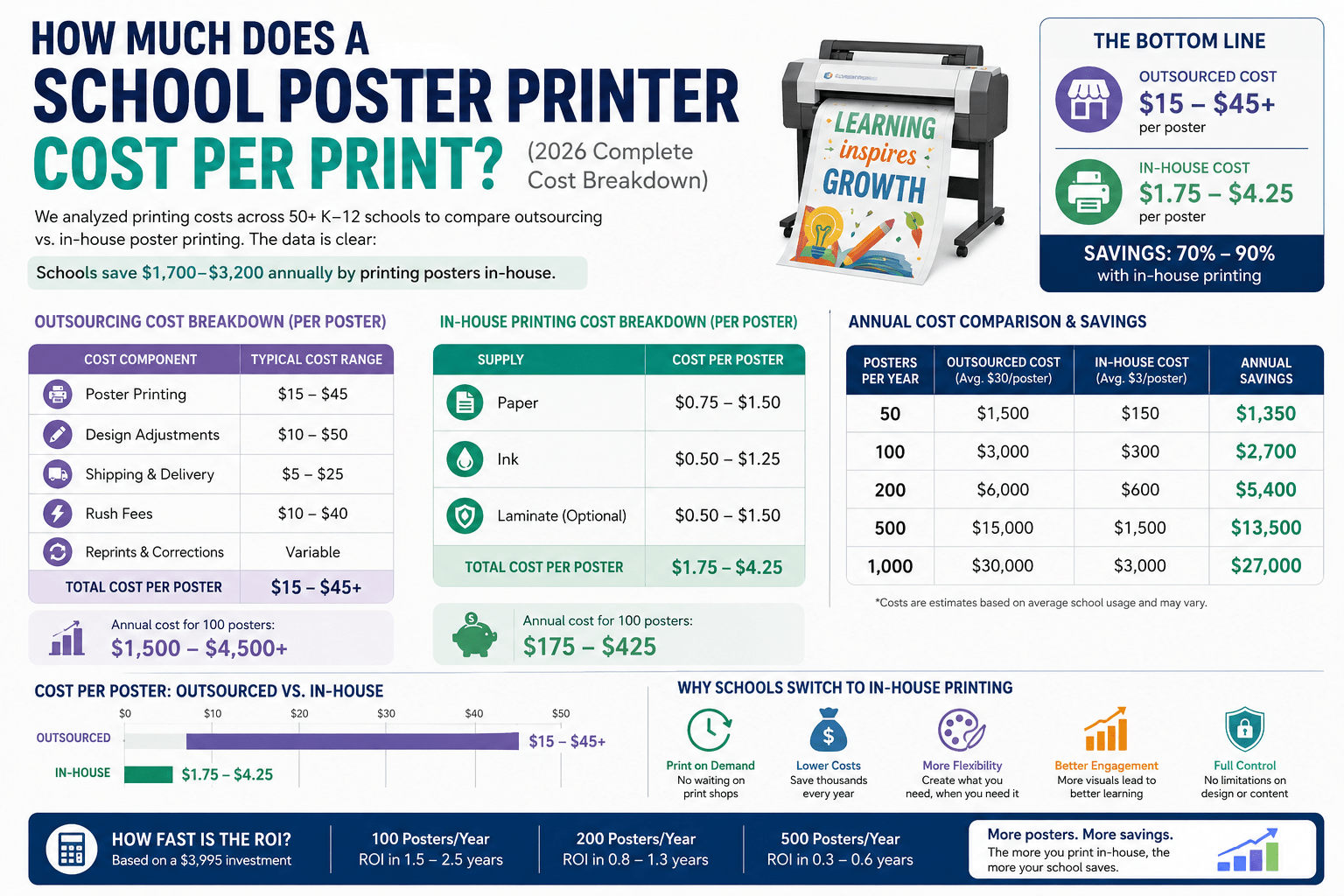
20 teachers × 3 posters × 9 months × $22 = $11,880 annually
Five years: nearly $60,000.
Now compare that with in-house production using a properly configured poster printer machine.
Average cost per 24×36 print (ink + paper): $4–$6.
Using $5 as a working number:
20 × 3 × 9 × $5 = $2,700 annually.
Five years: $13,500.
Add equipment investment (typically $8,000–$12,000).
Five-year total: roughly $22,000–$25,000.
Even on conservative estimates, schools often reduce five-year printing costs by $25,000+.
But here’s the more important reality:
When cost drops from $25 to $5, printing volume increases.
That means more instructional visuals, not just cheaper ones.
In Title I schools, visual consistency directly supports access.
Students who struggle with working memory or language processing rely heavily on visible scaffolds:
A Title I reading specialist shared this:
“My intervention students check the wall constantly. If the visual isn’t big enough to see from their seat, it doesn’t exist to them.”
That’s not theory. That’s daily classroom behavior.
If visual access improves student independence, then restricting large-format printing becomes an equity issue.
A poster printer machine in a Title I building isn’t cosmetic — it’s structural.
Projection is temporary.
Printed visuals are persistent.
STEM classrooms require visible process maps that stay up:
A STEM coordinator once put it plainly:
“We were projecting everything because printing large was too expensive. But once it’s off the screen, it’s gone. The wall keeps teaching.”
Persistent visuals reinforce process memory.
And process memory drives problem-solving ability.
Not every wide-format printer belongs in a school.
A true poster printer machine for schools must solve instructional problems — not just print large paper.
Here’s the standard I use when advising districts:
It must increase instructional output.
If teachers don’t print more after installation, the system failed.
It must reduce cost per poster to under $6.
If you’re not dramatically below print shop pricing, you’re not improving budget efficiency.
It must be simple enough that any teacher can use it without technical support.
If it requires a specialist to operate, adoption drops.
It must support 24” anchor charts and STEM visuals clearly readable from anywhere in the room.
If students can’t reference it from their seats, it isn’t serving its purpose.
That’s it.
The best poster printer machine for schools isn’t the most advanced model on the market.
It’s the one that removes friction, lowers cost, increases visual density, and strengthens classroom instruction.
When districts evaluate with those criteria, the right decision becomes obvious.
Here’s where districts often miscalculate.
They purchase a powerful commercial wide-format printer designed for:
These machines are impressive — but not optimized for teacher workflow.
If software is complex or supply costs are unpredictable, usage drops.
And unused equipment has zero ROI.
A school-based poster printer machine must prioritize:
If teachers hesitate, adoption fails.
Systems designed specifically for schools — like the Education Graphics Poster Maker from Education Graphic Solutions — consistently see higher usage because they are built around how educators actually work.
Infrastructure must match environment.
Before purchasing any poster printer machine, ask:
If you cannot answer these clearly, you’re not ready to purchase yet.
If you can — the decision becomes straightforward.
Schools do not debate whether they need whiteboards.
They do not debate whether they need projectors.
They recognize those tools as instructional infrastructure.
Large-format visuals serve the same function — they extend instruction beyond the teacher’s voice.
A poster printer machine is not about aesthetics.
It’s about:
When districts evaluate it correctly, it stops being a discretionary expense and starts being a strategic investment.
And schools that make that shift rarely return to outsourcing.