
DISCOUNTED EDUCATION PRICING! CALL 1-877-891-8411. We Gladly Accept School Purchase Orders!
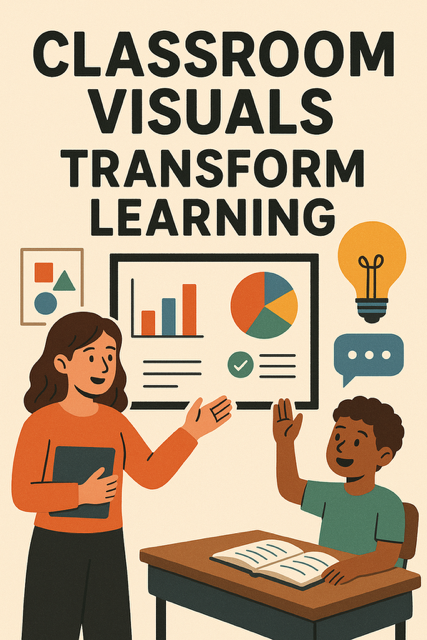
Classroom visuals aren’t just decorations—they are cognitive tools. When strategically designed, they boost comprehension, improve retention, support multilingual learners, and increase engagement. In today’s fast-paced, diverse classrooms, visuals are one of the most effective and research-backed instructional tools available.
This guide breaks down the research, classroom applications, teacher questions, and high-impact visual strategies proven to elevate learning.
Visuals improve learning comprehension by up to four times, according to decades of cognitive science research from experts like Richard Mayer and Allan Paivio.
Classroom visuals include:
They can be digital or printed, permanent or rotating, student-created or teacher-made. What matters most is purposeful design.
Richard Mayer’s multimedia learning research demonstrates that pairing visuals with words leads to significantly better comprehension than text alone.
Allan Paivio’s Dual Coding Theory shows that information stored as both verbal and visual representation creates stronger memory pathways.
Bottom line: visuals make learning stick.
Complex concepts overload working memory. School visuals simplify that load by breaking information into digestible, organized pieces.
This especially helps:
Eye-tracking research has shown that students look at, focus on, and interact more meaningfully with visual information—especially color-coded visuals.
A 2020 review in Educational Psychology Review found that visual representations significantly improve conceptual understanding in science, math, and engineering.
When students can see a concept—photosynthesis, fractions, grammar functions—it finally makes sense.
Answer:
No—older students benefit equally, often even more.
Secondary students gain clarity from:
The more abstract the content, the more necessary visuals become.
Answer:
Yes. Research on classroom distraction shows overly busy walls reduce attention and decoding efficiency.
The rule is simple:
Every visual must have a purpose.
Intentionality beats quantity.
Answer:
Both matter.
Teacher-created visuals model structure and accuracy.
Student-created visuals build deep learning because students reprocess information into diagrams, posters, and charts.
A Journal of Educational Psychology study found that students who generate visuals demonstrate higher conceptual mastery.
Best placement zones include:
Avoid placing important
in cluttered corners or under shelves.
These document strategies, processes, and expectations. They work best when co-created with students instead of pre-made.
They stabilize routines, reduce anxiety, and improve transitions—particularly for students with autism, ADHD, and multilingual needs.
These include Venn diagrams, cause–effect charts, story maps, and flowcharts.
Research consistently shows they improve writing quality and comprehension across subjects.
Infographics turn dense ideas into visually digestible information.
Concept maps reveal relationships and help students visualize patterns across subjects.
Posters reinforce:
Large-format posters are especially effective because they remain visible from anywhere in the room.
Visuals reduce language load and help multilingual learners decode:
Stanford ELL research confirms that multilingual learners consistently perform better when text is paired with supportive visuals such as images, diagrams, icons, and annotated models. These visual cues reduce language load, help students decode meaning more quickly, and make abstract academic vocabulary more concrete. When learners can connect a new term or concept to a visual anchor, they experience stronger comprehension, more confident participation, and significantly higher retention rates across subjects.
Use large text, breathing room, and consistent formatting.
Color creates category memory. For example:
Icons help students decode meaning instantly, even before reading.
Rotate classroom visuals with new units so they stay relevant.
Big visuals promote visibility, reduce confusion, and bring a professional, inspiring look to the classroom.
A visual schedule answers this.
Step charts and diagrams help.
Word walls with icons provide instant clarity.
Flowcharts and “start here” visuals reduce confusion.
School visuals reduce the need for repeated verbal reminders.
Examples include:
Classrooms using visual routines often experience fewer disruptions and more independent student behavior.
Modern classrooms are shifting toward:
Visuals will continue to be central as students interact with increasingly complex information.
Visual learning is one of the most powerful pathways the brain uses to process information. Nearly 70% of the brain’s sensory receptors are dedicated to vision, which means students naturally absorb and interpret information more effectively when it is presented visually. Research from the University of Michigan and cognitive scientists like John Medina consistently show that the brain retains visual information far longer than text alone—sometimes by a factor of several hundred percent. Visual learning also supports faster comprehension, reduces ambiguity, and helps students of all abilities anchor new concepts to something they can see. Whether it’s a diagram, chart, poster, or icon, visuals give students a mental “map” that strengthens understanding, boosts recall, and creates a more inclusive and accessible classroom environment.
Classroom visuals are far more than decorations—they are scientifically supported learning tools that:
In short: classroom visuals transform learning.
When designed intentionally, they turn the classroom itself into a dynamic teaching partner.