
DISCOUNTED EDUCATION PRICING! CALL 1-877-891-8411. We Gladly Accept School Purchase Orders!
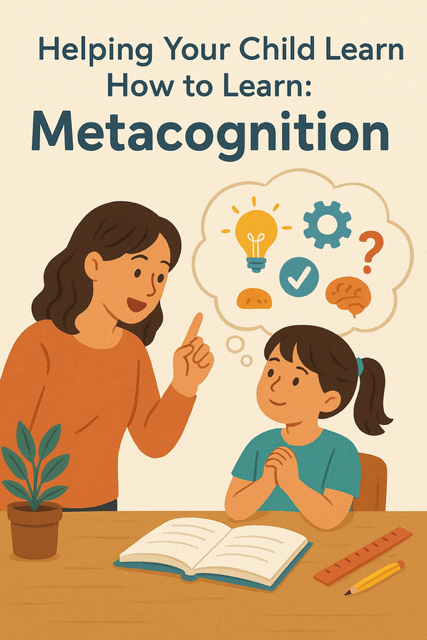
Picture this: your child sits down to study. They open the notebook, scan a few pages, and suddenly say, “Wait, I don’t understand this part yet — maybe I should try another way.”
That single moment — that pause to think about how they’re thinking — is the difference between a child who memorizes and forgets, and a child who truly learns for life.
Welcome to the world of metacognition — the art of helping children understand how they learn. And as a parent, you can nurture it right at your kitchen table.
In today’s world, facts are everywhere. Information is cheap. What matters most is whether your child can find, understand, and use that information effectively.
That’s where metacognition — often called “thinking about thinking” — comes in. When children understand how their brains work while learning, they can adapt, problem-solve, and persevere through challenges.
Think of it as the user manual for your child’s brain.
Children who use metacognitive strategies don’t just study longer — they study smarter. They plan before starting, check progress mid-way, and reflect afterward. Over time, this cycle of planning, monitoring, and evaluating builds confidence, independence, and curiosity.
In other words: when your child learns how to learn, they become unstoppable.
Metacognition isn’t an abstract theory — it’s a set of small, concrete habits that change how a child approaches every task.
It might look like your child:
These moments build self-awareness. A metacognitive learner becomes someone who doesn’t panic when stuck — they troubleshoot. They don’t depend solely on teachers or parents to tell them what to do — they take charge of their own progress.
That’s not just useful for school. It’s a superpower for life.
Research in educational psychology has consistently shown that metacognitive learners outperform their peers across subjects and age groups.
Why? Because metacognition sits at the intersection of knowledge and control. It’s both knowing how you learn best and being able to manage that process in real time.
When students consciously plan, check, and adjust, their brains build stronger neural connections. They don’t just memorize — they understand.
And the earlier these habits start, the stronger they grow. Even preschoolers can learn to reflect on their thinking when guided gently. Asking, “How did you figure that out?” or “What helped you solve that puzzle?” starts wiring their brains for metacognitive awareness.
By elementary school, children who’ve developed metacognitive habits tend to show greater motivation, resilience, and independence. They see learning not as something that happens to them, but as something they can control.
That mindset carries through adolescence, higher education, and even adulthood.
You don’t need a degree in psychology to raise a metacognitive learner. Other than visual teaching strategies, what matters most is creating small, consistent habits that help your child think about their thinking.
Here’s how to start:
When you solve problems in daily life, narrate your process. For example:
“I’m not sure where I put my keys. Let me think — what’s the last thing I remember doing before that?”
Or while cooking:
“This recipe didn’t work last time. Maybe I should try reading all the steps first so I don’t miss one.”
These “thinking aloud” moments show your child that everyone — even adults — plans, monitors, and adjusts.
They learn that problem-solving isn’t magic. It’s mindful.
Instead of asking, “Did you finish your homework?”, try questions that encourage reflection:
These simple prompts gently train your child to plan ahead, monitor progress, and evaluate afterward — the three pillars of metacognitive thinking.
Over time, your child begins to ask these same questions internally, automatically. That’s when learning becomes self-driven.
After school or study sessions, take two minutes to reflect together. Ask:
“What went well today?”
“What was hard?”
“What might you do differently next time?”
This builds what experts call self-regulated learning — the ability to manage one’s own motivation and strategy use.
Make it visual if you can. A “learning journal” or “strategy wall” where your child tracks what works for them can make metacognition feel real and rewarding.
Children often get stuck using one method for everything — rereading notes, highlighting, or cramming.
Encourage experimentation. Ask,
“Would drawing this help you remember it?”
“Could you teach it to me like a teacher?”
“What if you made flashcards or a mind map?”
Show them that learning strategies are tools, not rules. The more tools they try, the better they’ll understand which ones fit which jobs.
Instead of “You’re so smart,” try,
“I love how you figured out a new way to solve that.”
“You stopped and rethought your plan — that was clever.”
When you praise thinking, not innate ability, you’re sending the message that intelligence grows through strategy and reflection.
This builds both metacognition and a growth mindset — a combination that turns frustration into curiosity.
Learning how to learn doesn’t have to happen at a desk. You can weave metacognitive lessons into everyday routines and games.
Ask your child to plan the recipe, gather ingredients, and evaluate the outcome.
“What step do we start with?”
“Why do you think that didn’t turn out right?”
They’re planning, monitoring, and reflecting — all core metacognitive skills.
While reading, pause and ask:
“What do you think will happen next?”
“Why do you think the character did that?”
“Did the story make sense? What confused you?”
This teaches your child to self-check for understanding, an essential reading strategy.
After a game, ask:
“What strategy worked best?”
“What could you change next time?”
You’re teaching them to evaluate and adapt — exactly what metacognitive thinkers do in school and in life.
When drawing, building, or crafting, discuss:
“How did you decide what to make?”
“What did you change halfway through?”
“What are you proud of?”
Every reflection reinforces awareness of process, not just product.
These small, casual moments build big cognitive habits — without feeling like extra work.
Even well-meaning parents sometimes make moves that unintentionally limit metacognitive learning. Here’s what to watch for:
1. Solving too quickly.
When your child struggles, resist the urge to jump in. Give them space to think, ask guiding questions, and encourage them to test ideas.
2. Focusing only on results.
If success equals “getting it right,” your child will fear mistakes. Instead, define success as figuring it out, trying new strategies, and learning from errors.
3. Rushing reflection.
Reflection often happens last — when everyone’s tired. But it’s crucial. Even one or two reflective questions each day strengthen your child’s learning muscles.
4. Believing metacognition will develop on its own.
It won’t. It needs modeling, conversation, and intentional practice. Just five minutes a day can build the habit of mindful learning. Anchor charts can help.
If you’re ready to make metacognitive thinking part of family life, start small with this simple rhythm:
Monday: Before homework, ask, “What’s your goal for today? What strategy will help you reach it?”
Tuesday: Mid-task, pause and ask, “How’s your plan working so far?”
Wednesday: After finishing, reflect: “What did you learn about your process?”
Thursday: Experiment day. Encourage your child to try one new strategy — visualizing, summarizing, or teaching aloud.
Friday: Wrap up the week. “Which strategies worked best? What will you keep doing next week?”
Consistency matters more than duration. Over time, these five-minute conversations reshape how your child approaches learning altogether.
We’re raising children in a world that changes faster than any generation before it.
The skills that matter now — adaptability, curiosity, creative problem-solving — all depend on one thing: the ability to learn new things effectively.
Helping your child learn how to learn gives them that advantage. It’s not about turning your home into a classroom. It’s about helping them see that every challenge is a chance to grow.
When your child says, “I can’t do this,” metacognition helps them reframe it as, “I can’t do this yet.”
That’s the mindset that fuels innovators, entrepreneurs, and leaders. It begins not with a textbook, but with a conversation — one that starts right at home.
You don’t need more homework battles or expensive tutoring sessions to raise a lifelong learner. You just need to start asking — and modeling — better questions.
When your child approaches any task, ask:
Those three questions turn every moment into a learning moment.
Because in the end, the most valuable lesson your child can learn isn’t math, grammar, or science.
It’s how to learn anything, anytime, for life.