
DISCOUNTED EDUCATION PRICING! CALL 1-877-891-8411. We Gladly Accept School Purchase Orders!
Quick answer: Most K–12 schools should run 135 gsm matte poster paper for roughly 90% of what they print — anchor charts, classroom posters, PBIS signage, and student work displays. Matte is glare-free under fluorescent and LED classroom lighting, it accepts pigment ink cleanly, and it’s the least expensive roll per square foot. Reach for satin only when color punch matters more than readability, adhesive vinyl when you’re printing on doors, floors, or windows, and banner media when the print has to survive a gym, a hallway, or the weather.
That’s the short version. The longer version is worth five minutes, because paper is the single most common reason a school’s posters come out looking worse than the school expected — and it’s almost always fixable for free.
Schools spend weeks choosing a machine. We know — we’ve walked thousands of districts through it, and we wrote a whole guide on how to choose the right poster printer machine for your school because the decision deserves that care.
Then the printer arrives, someone loads whatever roll was in the box, and nobody thinks about media again for two years.
Here’s the thing: the printer isn’t what makes a poster look cheap. Paper is. A well-calibrated wide-format printer running the wrong media will produce dull color, visible banding, ink that smears when a student brushes past it, and text that’s hard to read from the back row. Swap the roll, change one driver setting, and the same file prints beautifully.
Paper is also the only ongoing cost you fully control. Hardware is a one-time purchase order. Paper and poster printer ink are what you reorder — so getting the choice right compounds across every print for the life of the machine.
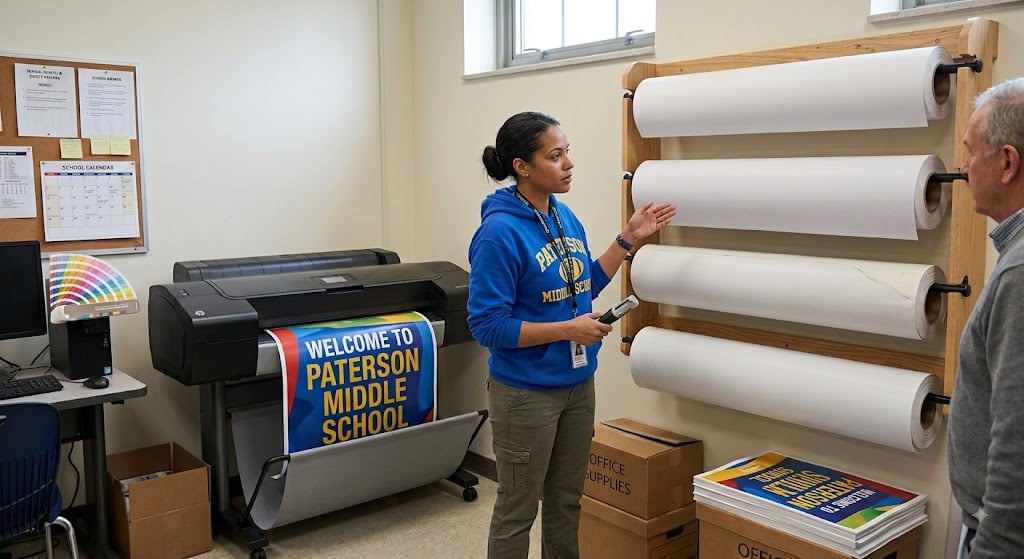
You don’t need a dozen options. You need to know which of these four is on the machine right now, and when to switch.
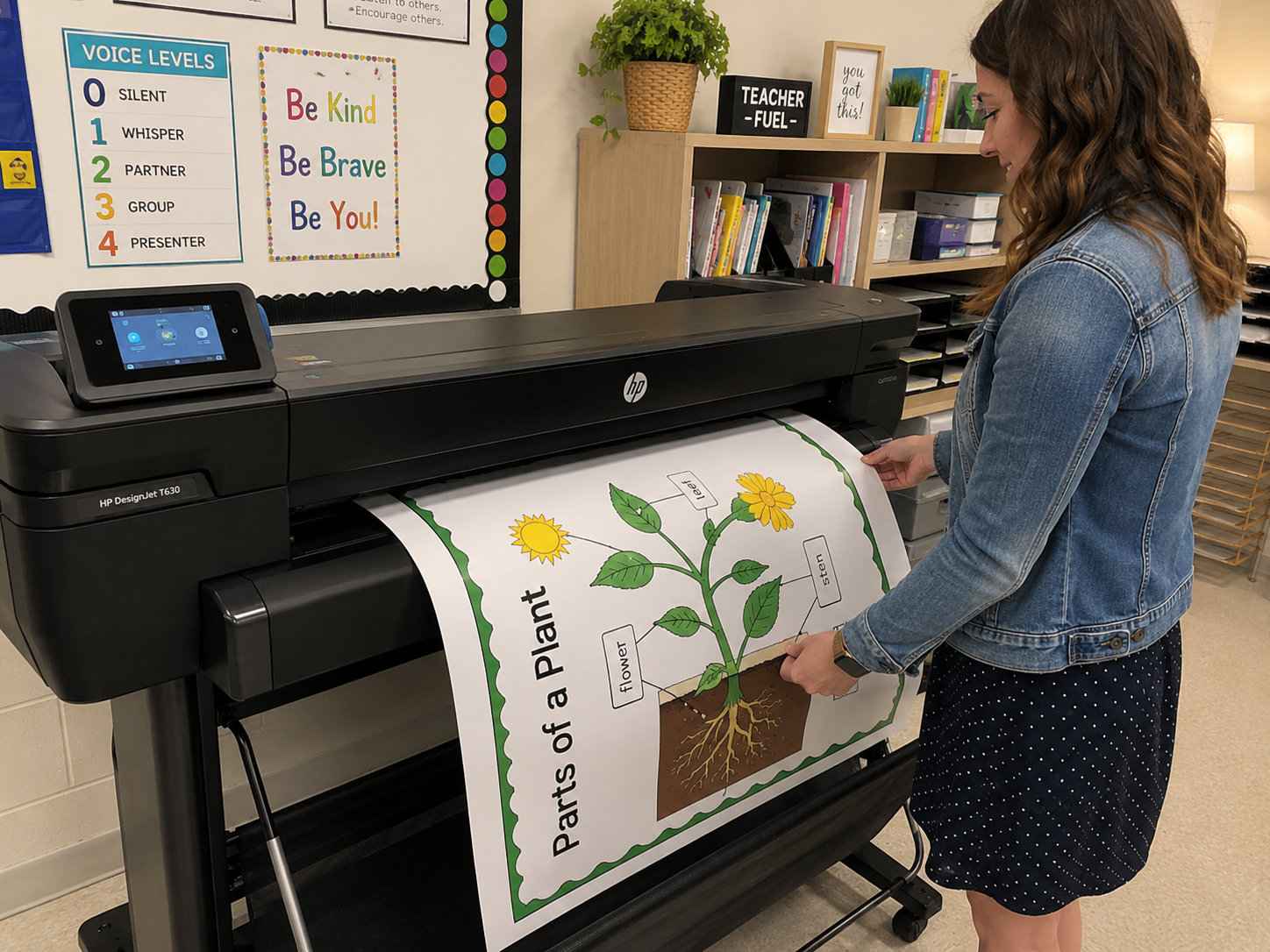
Use it for: anchor charts, instructional posters, word walls, data walls, PBIS expectation posters, student work displays, science fair boards, bulletin board backing.
Matte is the workhorse. The reason is physics, not preference: classrooms are lit from directly overhead by fluorescent tubes or LED panels, and a glossy surface bounces that light straight into the eyes of the students sitting under it. A gorgeous glossy poster is unreadable from row three. A matte poster is readable from the back of the room.
Matte also holds fine text and thin lines better than coated stocks, which matters more than people expect for anchor charts — the whole point of an anchor chart is that a student can read it from their seat while working.
Weight: 135 gsm is the standard school-grade matte. It’s substantial enough to hang flat without curling at the corners and rigid enough to survive being taped, re-taped, and moved between classrooms. Lighter stocks (around 90–120 gsm) save a little money and wave in the HVAC draft. Heavier stocks cost more and mostly benefit prints you plan to mount.
Use it for: athletics banners on interior walls, senior night and signing day displays, yearbook and photography showcases, art department prints, front-office recognition displays.
Satin sits between matte and full gloss. It deepens blacks and saturates color noticeably — photographs in particular look flat on matte and come alive on satin. The tradeoff is glare, so use it where the viewer isn’t standing directly under a light fixture, or where the poster is being admired rather than read.
Rule of thumb we give schools: if it’s teaching, print matte. If it’s celebrating, print satin.
Use it for: door graphics, window signage, floor decals for traffic flow and social-distancing lanes, stair risers with multiplication facts or vocabulary, locker banks, cafeteria signage.
Adhesive media is the one that surprises schools. Once a building has it, the printer stops being “the poster machine” and becomes the tool that handles the whole facility’s visual identity. Stair risers alone have converted more than a few skeptical principals — every student reads them twice a day whether they mean to or not.
Two cautions worth knowing before you order: adhesive stock is thicker and needs the media type set correctly in the driver or you risk a head strike, and removability varies by product. Ask specifically about removability before you put anything on painted cinder block or a gym floor.
Use it for: gym banners, outdoor event signage, homecoming and graduation displays, field day, fundraising thermometers, anything that gets rolled up and reused annually.
Banner stock is tear-resistant and, depending on the product, water-resistant. It’s the right call for anything that has to survive handling, storage, and a second season of use. It’s also the natural fit for 44″ widths — a banner that reads across a gym needs the scale.
You can see the full range of stocks, weights, and widths on our poster printer paper and supplies page, and if you’re not sure which applies to a project your building is planning, call us before you order. We’d rather spend five minutes on the phone than have a roll sit unused in a supply closet.
| What you’re printing | Media | Weight | Why |
|---|---|---|---|
| Anchor charts, classroom posters | Matte | 135 gsm | Glare-free, sharp text, lowest cost |
| Word walls, data walls | Matte | 135 gsm | Readable from any seat |
| PBIS & hallway signage | Matte | 135 gsm | Consistent, high-legibility |
| Team banners, senior night | Satin | 135–200 gsm | Deep color, photo quality |
| Art & photography displays | Satin | 200 gsm+ | Saturation and tonal range |
| Door, window, floor graphics | Adhesive vinyl | — | Sticks to non-wall surfaces |
| Gym and outdoor banners | Banner media | — | Tear- and water-resistant |
| Reusable annual displays | Banner media | — | Survives storage and rehanging |
[VERIFY BEFORE PUBLISHING] Confirm the exact gsm figures and available widths against your current SKU list on
/poster-printer-paper-supplies/. The 135 gsm matte figure is drawn from your existing site content; the satin and banner weights are industry-typical and should be replaced with your actual product specs.
This is the part schools ask about most, usually about eight months in, usually starting with “it used to look better than this.”
1. Glossy paper in a fluorescent classroom. Covered above, but it’s the number one complaint we field and it’s a purchasing decision, not a printer problem. Somebody ordered the wrong roll because glossy sounded like the premium option.
2. The driver media setting doesn’t match the loaded roll. This is the big one. Your printer lays down a different volume of ink depending on what it thinks is loaded. Tell it “photo gloss” while matte is on the spindle and you get oversaturated, slow-drying prints that smudge and bleed. Tell it “plain paper” while satin is loaded and you get washed-out color. It takes four seconds to set correctly and it’s the difference between “our printer is amazing” and “our printer is disappointing.”
3. Storing rolls standing on end. A roll left upright on a concrete floor develops a flat spot and a compressed edge. That crushed core telegraphs into every print as a feed inconsistency or a visible line. Store rolls horizontally, in their original packaging, on a shelf.
4. Humidity. Custodial closets, boiler rooms, and rooms that get shut down over summer break are where paper goes to absorb moisture. Damp media cockles, feeds unevenly, and takes ink badly. A climate-controlled interior closet is fine; the room next to the pool is not.
5. Letting the machine sit idle over the summer. Pigment ink printers do best with occasional use. A machine that sits from mid-June to late August may need a printhead cleaning cycle and a test print before it’s back to full quality — which is exactly why late July is the right time to run a check, not the first in-service day when a teacher needs forty posters.
If you’re reading this in August: run a nozzle check now, order paper and ink now, and start the year with a machine that works instead of a help ticket.
Often, no — and this saves schools real money.
Pigment inks resist fading and smudging on their own. A matte anchor chart printed with pigment ink and hung in a classroom will still look sharp in June rather than sun-bleached by October. For most instructional posters, lamination is an unnecessary step and an unnecessary cost.
Laminate when the print will be handled, not just seen:
For that work, a hot laminator gives the most durable, permanent finish. A cold laminator is gentler, faster to start (no warm-up), and safer around students and student helpers — which is why media specialists tend to prefer it. Refills for cold systems, including Xyron standard laminate refills, are inexpensive to keep on hand.
Deciding between the two mostly comes down to who’s operating it. If students help, go cold.
Schools consistently underestimate this, so plan generously.
The pattern we see is that a poster printer gets used far more than anyone projected. A machine bought “for the science wing” is serving kindergarten word walls, the front office, athletics, and the counseling department within a month. Our post on 100 ways schools use poster printer machines isn’t a hypothetical list — it’s compiled from what buildings actually print.
Practical guidance:
Media choice is a real input to your cost per print, but it’s a smaller variable than most people assume — the savings versus outsourcing swamp it.
Printing in-house runs roughly $1.30–$2.84 per poster depending on coverage, size, and media, against $20 or more at a local print shop. Even the most expensive stock in your closet is dramatically cheaper than sending a file out. We break the arithmetic down fully in how much it costs to print posters at school.
Two things follow from that:
First, don’t cheap out on media to save pennies. The difference between a budget roll and the right roll is a few cents per print, and a poster nobody can read is a total loss regardless of what it cost.
Second, if you’re still outsourcing, the paper conversation is premature. The savings come from bringing printing in-house at all. Our buyer’s guide to the best school poster printers for 2026 is the place to start, and our poster maker packagesbundle the machine with paper, ink, and warranty so nothing’s missing on day one.
We built our ordering process around how schools actually buy, not how retailers wish they did.
What weight paper should schools use for classroom posters? 135 gsm matte is the standard for K–12 classroom use. It hangs flat, resists curling, handles repeated taping, and gives sharp, glare-free text under overhead classroom lighting.
Is matte or glossy better for school posters? Matte, for nearly everything instructional. Glossy and semi-gloss reflect overhead fluorescent and LED light, which makes posters hard to read from the middle and back of a classroom. Use satin only for photo-heavy or celebratory displays where color saturation matters more than legibility.
Can we use regular paper in a wide-format poster printer? Only if it’s rated for the machine and the driver is set accordingly. Uncoated or non-rated stock absorbs ink unpredictably, produces muddy color, and can shed fibers into the paper path. Media designed for large-format pigment printing costs marginally more and performs enormously better.
How long does a roll of poster paper last? It depends on print size and building demand. A single 24″ roll produces a substantial number of 24″ x 36″ posters, but active buildings move through paper faster than they expect — most schools that budget for one roll per semester end up reordering sooner. Keep a spare on hand.
Do school posters need to be laminated? Not usually. Pigment inks resist fading and smudging without lamination. Laminate prints that will be physically handled — student manipulatives, primary-grade materials, high-traffic signage, and anything you’ll store and reuse next year.
Can we buy poster paper with Title I funds? In many cases, yes, when the supplies support instructional materials for eligible students. Allowability is determined by your district. See our funding guide for the categories most commonly used.
How should we store poster paper rolls? Horizontally, in original packaging, in a climate-controlled interior space. Never standing on end, and never in a damp closet or an unconditioned room.
Tell us what your building prints most and we’ll tell you what to load. No quote required for the question.
Call 1-877-891-8411 or contact our team. We’ll also send a free printed sample so you can see the media in your own classroom lighting before you commit to a case.
Browse Poster Paper & Supplies → Request a Quote →
Sarah Is Chief Creative Officer at Education Graphic Solutions, where they have helped K–12 schools and districts specify large-format printing systems and supplies since [year]. Education Graphic Solutions is an authorized HP partner and TIPS purchasing cooperative member that has worked exclusively in K–12 education since 2003, supporting more than 5,000 schools nationwide.
Questions about media for your building? Reach the team at sales@educationgraphicsolutions.com or 1-877-891-8411.
Learn more about Education Graphic Solutions or read our school poster printer FAQ.